
Why Joy, Why Now?
By Julia Rubin and Mary Beth Thompson
Directors of Teaching and Learning, Crystal Springs Uplands School
At Crystal, we’ve decided to be bold this year and focus on joy. More specifically, the joy of invention.
But why joy? Why now?
Perhaps, like you, joy is not the first word that comes to mind when we think about our world or this particular moment. There is a lot that feels heavy and uncertain. In schools, too, we are being asked to respond to change at a pace that can sometimes feel relentless. And yet, that is part of what makes joy so necessary.
Teaching has always been an act of invention. We design lessons and assessments. We shape spaces for learning. We build deep and meaningful relationships with students. We respond to what is happening in front of us, often adjusting in real time. All of this work takes ingenuity, insight, and time on task to develop one’s craft. It is some of the most meaningful work that humans can do, and we do it even better together. And all of this invention is the basis for the powerful sense of joy and reward that comes from our work.
So when we speak about the Joy of Invention, we do not mean joy as an escape from difficulty. We mean joy as something we practice. Something we make room for, even when the work is hard. In teaching, that can mean creating space for curiosity to take hold, for an idea to grow, for a student to surprise themselves, or for a class to discover something together.
And that kind of joy does not happen by accident. It takes intention and courage. It asks us to keep making room for possibility, even when certainty is in short supply.
There is also a growing body of work that reminds us that emotion is not separate from learning, and we believe this extends to both students and teachers as lifelong learners. Neuroscientist and education researcher Mary Helen Immordino-Yang has spent much of her career studying the relationship between emotion and learning. Her work suggests that emotion shapes what we attend to, what we find meaningful, and ultimately what we remember and learn. Perhaps joy, then, is not something we add to learning after the serious work is done. It can be part of what makes that work meaningful in the first place.
We see this in classrooms all the time. Joy often appears in small moments. A question takes a lesson somewhere no one expected. A student becomes absorbed in making something of their own. An experiment does not work, and the failure becomes the beginning of a better idea. A conversation catches fire because students realize they have something real to say.
These moments are not interruptions to learning. Very often, they are the learning.
The same is true for educators.
Some of the most energizing moments in our work happen when we are given the time and trust to create with one another. We hear an idea from a colleague that changes the way we think about our own classroom. We rethink an assignment we have taught for years. We try something new and come back together to talk about what happened. We wrestle with a problem that does not have an obvious answer and discover that someone else has been wrestling with it, too.
Immordino-Yang’s idea of “transcendent thinking” offers a useful frame for what can happen when educators learn in community. By stepping beyond the immediate demands of our own classrooms, we can begin to see patterns, systems, and possibilities that are harder to recognize alone, sometimes arriving at the kind of shared insight that changes not just a lesson, but how we understand the work of teaching itself.
Professional learning at its best feels less like receiving information and more like participating in a shared act of invention.
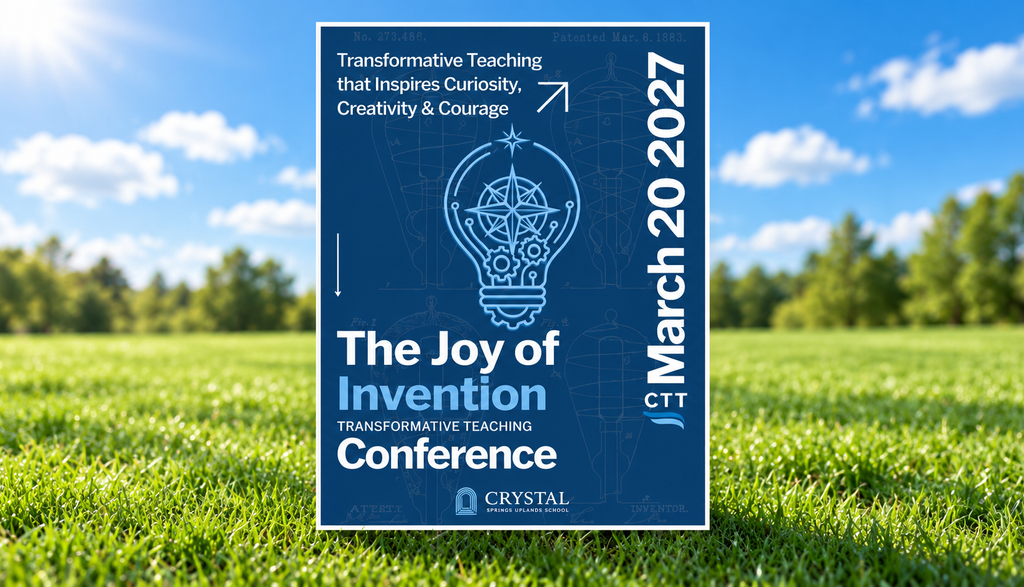
That is the spirit behind this year’s Transformative Teaching Conference at Crystal Springs Uplands School. On March 20, 2027, we are inviting educators to come together not because any of us has figured out the future of teaching, but because there is something powerful about figuring things out together.
This year’s theme, The Joy of Invention, grew out of a desire to celebrate the creative work already happening in schools and to make space for more of it. We want to explore what becomes possible when curiosity drives learning, when experimentation has a place in our classrooms, when students experience greater ownership, and when educators have permission to rethink familiar practices.
We are especially interested in work that is still becoming. The experiment that is not quite finished. The practice you are still refining. The question you cannot stop thinking about.
There can be enormous pressure in education to present finished products, but invention rarely works that way. Ideas develop through use and conversation. They change when they encounter other people. Often, they become more interesting when someone asks the question we had not thought to ask.
That is why we want this conference to remain deeply teacher-powered. So much of the expertise we need already exists within our classrooms and schools. What we need are more opportunities to bring that expertise into conversation, to learn across contexts, and to make something new together.
We do not know exactly what schools will look like ten years from now, or perhaps even first years from now. That uncertainty is real. But perhaps that is precisely why invention matters, and why joy matters with it.
Joy gives us energy for the work of imagining what might be possible. And when we do that work together, uncertainty can become something other than a source of anxiety. It can also become an invitation.
We hope you will join us.
AUTHORS

Julia Rubin is the Upper School Director of Teaching and Learning at Crystal Springs Uplands School. Before moving into an administrative role, Julia taught English, French, and Creative Writing at the middle school, high school and community college levels for 12 years. She mentored early career teachers for 5 years at Hillbrook School, where she also served as Writing Coordinator and Humanities Team Lead. As a researcher, she is trained in human-centered design and applications of educational technology to improve student outcomes. Julia is particularly interested in unleashing the creative potential in both teachers and students as they navigate the process of making equity work a lived experience in classrooms.

Mary Beth Thompson is the Director of Teaching and Learning at Crystal Springs Uplands Middle School, partnering with faculty and department chairs to strengthen curriculum, instructional practice, and student well-being. She supports the Center for Transformative Teaching, guides cross-divisional initiatives in curriculum alignment, AI, and DEI, and supports faculty through growth-focused coaching and professional development. With over fifteen years of experience as a teacher, school board member, and school leader, Mary Beth believes in the lifelong potential of every learner and works to cultivate classrooms where curiosity, connection, and compassion shape who students become.